 trendhub
Table of Contents
It is a paradox of modern digital work that is as painful as it is universal: the discrepancy between the time we invest in creation and the time this creation is granted to breathe is growing relentlessly. We spend hours, often days, researching, polishing, and producing content meant to have substance. We upload it, hoping for resonance, for a dialogue, for a cultural imprint. Yet, what follows is often merely a brief, almost nervous flicker of visibility—a dopamine spike of two hours—before digital darkness sets in. The work isn’t bad; it has simply become the victim of a hostile architecture. We are building cathedrals on ground that moves like quicksand.
This experience is not a personal failure, but a systemic design feature. We find ourselves in an era that we must designate as the End of Infinity. The Infinite Scroll, once celebrated as a gateway to limitless information, reveals itself as a dead end for human creativity. It suggests abundance but delivers only ephemerality. If we want to understand why our engagement rates are sinking and why even viral hits feel increasingly hollow, we must stop optimizing the content and start analyzing the space in which this content is forced to exist. We live in the Geometry of Forgetting, a digital landscape mathematically constructed so that the new does not merely supplement the significant, but actively and instantly overwrites it.
The Dictatorship of Speed: Why Friction Is Necessary
To understand the brutality of the modern feed, it is worth looking at the physics of fluids. Social platforms in their current form—be it TikTok, Instagram, or X—function like raging rivers. Their primary design goal is not depth or viscosity, but velocity. In the logic of platform capitalism, standing still is synonymous with lost revenue. When a user lingers on a post to think, reflect, or formulate a complex comment, they stop the flow of consumption. They see no new advertisements in that moment. The system, therefore, has an intrinsic interest in punishing lingering and rewarding moving on.
Here lies the fundamental conflict between human dialogue and algorithmic logic. A real dialogue, one that deserves the name, requires friction. It demands pausing, mentally stumbling over an idea, struggling for an answer. Friction is the resistance upon which understanding ignites. The algorithm, however, is a friction-minimizer. It smooths the path so that the thumb can glide without resistance. Content that is too complex, that demands too much cognitive labor, or that slows down the flow, is viewed as an obstacle in the stream and filtered out. We have created an architecture that prioritizes swiping over knowing. The result is a culture of shallow validation, where we merely nod to one another in passing because stopping is sanctioned.
The Sandcastle Principle: Cultural Amnesia as a Business Model
This fixation on the flow leads to a phenomenon that we can architecturally describe as the absence of a foundation. In the physical world, we build archives, libraries, and museums—places designed to store time. The feed, however, is an anti-archive. It is a place of the permanent present, a “now” that tolerates no history. Whoever publishes in a linear feed is literally building sandcastles at the tide line. It does not matter how artfully, stably, or brilliantly the castle is constructed; the next wave—the “refresh”—is programmed to level it.
This Geometry of Forgetting has profound psychological effects on creators and consumers. We are experiencing a kind of collective amnesia. Since content has no fixed locatable address, but only coordinates on a timeline, it loses its context as soon as it slips out of the visible window. The human brain, however, requires spatial anchoring and temporal permanence to transform information into knowledge. The so-called “Interference Theory” in psychology suggests that new information can disrupt the retrieval of old information if it is too similar and presented in too rapid succession. The feed is the technological manifestation of this interference: it overwrites short-term memory so aggressively with new stimuli that consolidation into long-term memory can barely take place. Forgetting here is not an accident; it is the prerequisite for the user remaining open to the next stimulus.
From Social Media to Social Broadcasting
The consequence of this architecture is a creeping but fundamental shift in our communication patterns. What we still euphemistically call “Social Media” has little to do with the social fabric of a network anymore. It has transformed into “Social Broadcasting”. We send, we broadcast, we shout into the forest—but the forest no longer answers; it only rushes by. Analyses show that we spend up to 80 percent of our time on these platforms in transmission mode (or in passive consumption of what is transmitted), but only establish a real connection in the remaining 20 percent—if at all.
The megaphone has become the symbol of our digital existence. We shout louder and louder, use ever-brighter colors and steeper theses, hoping that our signal will pierce the cacophony of the stream for split seconds before it is washed away. But a megaphone is not a telephone. It allows for no return channel that deserves the name. The comment sections below posts are not places of exchange, but graffiti walls where everyone quickly leaves their tag before the caretaker—the algorithm—paints over it again. This one-sidedness leads to a deep loneliness among the actors. We are hyper-connected but structurally isolated, trapped in an architecture that defines sending as work and receiving as consumption, but has eliminated the in-between—the understanding.
The Architectural Turn: From Line to Space
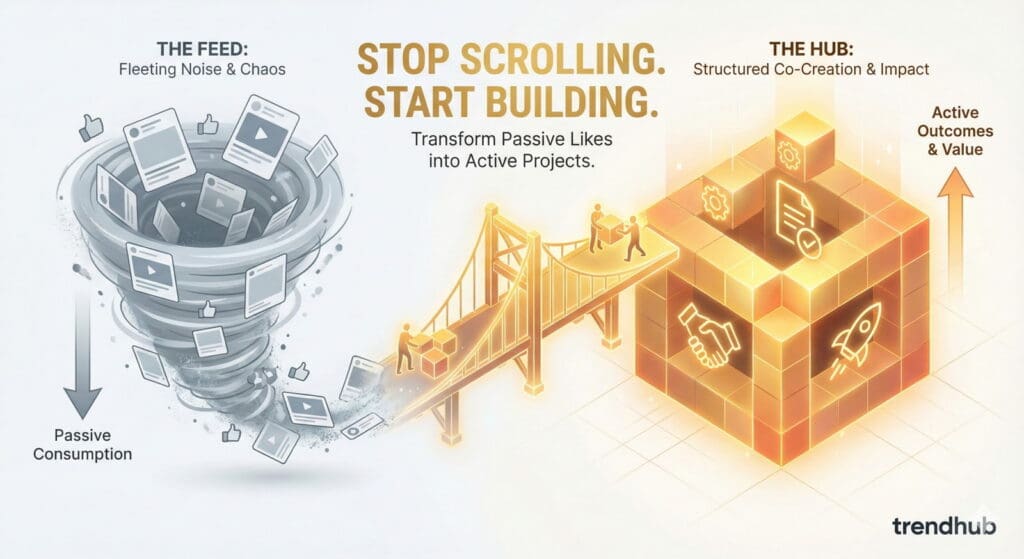
If the line is the problem, the solution must lie in the plane. We must shift digital architecture from a temporal logic (when was it posted?) to a topographical logic (where does it belong?). The solution to the dilemma of forgetting lies in the transition from linear feeds to structured spaces. We must stop “posting”—a term reminiscent of tacking a note to a pole—and start “projecting.” This means placing topics into spaces where they can grow, protected from the erosion of the constantly new.
It is precisely at this point that the philosophy of trendhub breaks with the status quo of the platform economy. Instead of bowing to the dictates of chronology, where the newest is always at the top, trendhub establishes an architecture of relevance. Here, a topic does not become irrelevant simply because it is “old”; it remains visible and central as long as the conversation adds value to it. It is the difference between an assembly line and a round table. At a round table, the quality of the argument determines the dynamic, not the time at which it was spoken. These structured spaces act as breakwaters in the geometry of forgetting. They create an artificial viscosity that forces the user to stop.
In this environment, the “friction” hated by conventional algorithms becomes the most valuable asset. Stopping, thinking, evaluating a contribution—these are not bugs in the system, but core functions. By understanding the community not as spectators of a stream, but as architects of a project, motivation changes fundamentally. One no longer builds sandcastles at the tide line, but lays stones for a foundation that remains. Content is not consumed and excreted; it is curated, refined, and archived.
Reclaiming Resonance
We must say goodbye to the illusion that more content or more sophisticated hooks can solve the problem of sinking engagement rates. That is like trying to save a sinking ship by rowing faster while ignoring the leak in the hull. The leak is the linearity. The way out of the Geometry of Forgetting leads only through a conscious decision for places that honor memory.
It is time to critically question the machines that feed on our attention by fragmenting our memory. Real connection arises where contexts are preserved, where discussions have a home, and where the value of a thought is measured not by its novelty, but by its substance. We must stop feeding the river and start building dams. For only in the stillness of standing water can the world reflect itself—and only there do we find our way back from sending to speaking.
Sources:
- On the concepts of dromology and speed: Virilio, P. (1977). Speed and Politics. Semiotext(e). See also: Stanford Encyclopedia of Philosophy
- On Interference Theory and memory: Anderson, M. C., & Neely, J. H. (1996). Interference and inhibition in memory retrieval. In E. L. Bjork & R. A. Bjork (Eds.), Memory. Academic Press. APA PsycNet
- On the attention economy and fragmentation: Citton, Y. (2017). The Ecology of Attention. Polity Press. Publisher’s Site
- On the distinction between places and non-places: Augé, M. (1995). Non-Places: Introduction to an Anthropology of Supermodernity. Verso. Verso Books