 trendhub
Table of Contents
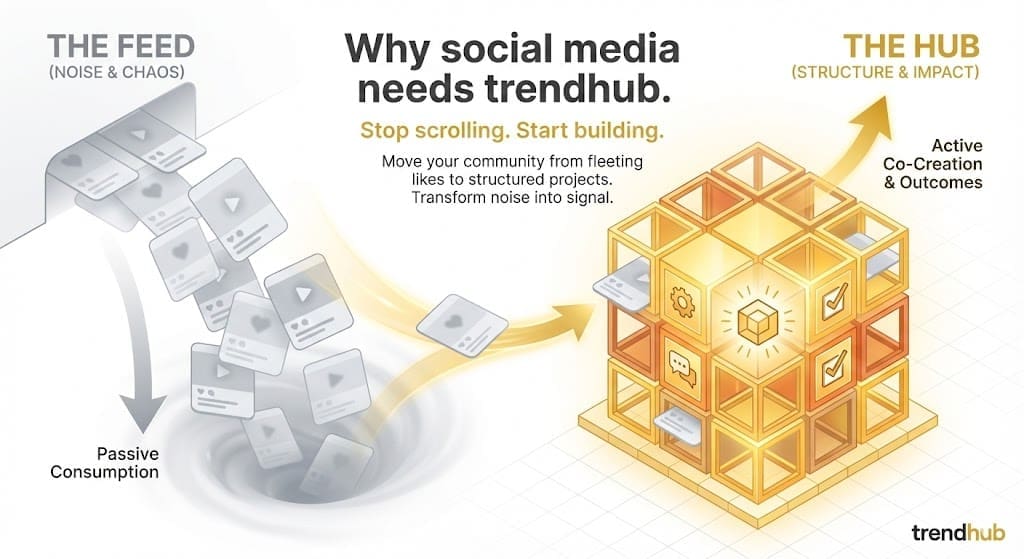
We are facing a digital wall. It is an invisible barrier, constructed from billions of short-lived video clips, fleeting text fragments, and endless streams of images. The promise of social media was once connection. Yet, if we look honestly into our screens, we must admit that we have traded this value for a far cheaper currency: Attention. We have spent the last decade optimizing our content, our thoughts, and even our social interactions for an algorithm programmed for transience. Between seven-second reels and the narcotizing rhythm of the infinite scroll, the actual point has been lost. The diagnosis derived from current digital exhaustion is clear: The architecture of the feed, as we know it, has reached its functional limit. It no longer generates community, but merely an audience. It promotes not work, but only consumption. It is time for a hard break and the question of why we settle for a digital infrastructure designed to make ideas fade as quickly as possible.
The Geometry of Forgetting
The fundamental problem is not the content itself, but the vessel in which it is served. The feed is linear, chronological, and mercilessly fleeting. In this architecture, the rule applies: Fast content equals fast forgotten. Neurologically, the infinite scroll creates a state that constantly overwrites short-term memory without granting the brain the necessary resting phase to consolidate information into long-term memory. Scientific studies on digital media usage suggest that the way we consume information in the feed—quickly, without context, and fragmented—significantly impairs our capacity for deep processing. We scan instead of understanding. A creative thought, a complex project, or a nuanced discussion stands no chance of survival in this stream because the platform architecture itself prioritizes the “new” over the “valuable.”
When we say that social media has “hit a wall,” we mean precisely this structural inability of current platforms to generate permanence. Ideas need a home, not a slot on a timeline that vanishes into digital nirvana after 24 hours. The human need for creation and preservation stands in direct contradiction to the economic logic of the feed, which is based on constant renewal. We suffer collectively from “Feed Fatigue,” an exhaustion born from the realization that our invested time and emotional energy are flowing into a black hole of insignificance. The solution cannot be more content. The solution must be structural in nature: We must create spaces that function not like rivers that wash everything away, but like foundations upon which we can build.
From Passive Viewing to Cognitive Participation
Perhaps the most deceptive aspect of the modern social media landscape is the illusion of interaction. A “like,” a heart, or a fleeting emoji comment is sold as engagement. Yet, psychologically speaking, the user remains in a passive consumer role. The American Psychological Association (APA) distinguishes clearly between passive use (scrolling, watching) and active use (interacting, creating), noting that the former correlates more frequently with negative effects on well-being (Source: APA Monitor on Psychology). In the current logic, the community is not a team, but an audience. Spectators sit in the stands, clap briefly, and go home. Yet humans carry a deep, evolutionarily anchored drive to effectively shape their environment, a concept known in psychology as self-efficacy.
Here lies the dormant potential of the Creator Economy. Followers are not just consumers; they are often intelligent, creative, and motivated. They don’t just want to “double-tap”; they want to participate. They want to be part of the process, not just recipients of the end product. If we take the term “community” seriously, we must decouple it from mere spectatorship and evolve it toward collaboration. This means not only making the barrier between sender and receiver more permeable but dissolving it structurally. In a world where everyone has access to the means of production, the artificial separation into “Creator” (the active one) and “Follower” (the passive one) is an anachronism. The next evolutionary stage of the internet will be defined by who manages to transform this passive mass into active co-creators.
Structure as an Antidote to Chaos
Why do so many attempts at genuine collaboration fail on Instagram, TikTok, or X? Because the tools are missing. A comment section is not a workspace; it is a chaotic, unstructured place built for quick reactions, not constructive development. Creators don’t just need an audience; they need a team. But a team without structure is just a crowd. To move from “noise” to “signal,” we require digital spaces specifically designed for the development of outcomes. This is the moment when the transition from “post” to “project” must be made. A post is a statement. A project is an invitation to a journey.
Platforms like trendhub position themselves exactly at this fracture point, not as another social network for even more reach, but as a “Social Project Network.” The idea behind it is as simple as it is radical: Instead of feeding the algorithm with ever-new stimuli, a structured space (a Hub) is created where feedback is not fleeting, but “item-based” and actionable. When users do not merely comment but vote on specific elements, contribute assets, and help determine the direction of a creative work, the psychological dynamic shifts from parasocial admiration to genuine cooperation. Structure creates not only order here but also psychological safety. In a clear framework, people are more likely to dare to make substantial contributions than in the wilderness of an open timeline.
The Shift of Currencies: From Gaze to Contribution
We are moving from an era of “Look at me” to an era of “Build with me.” This shift is fundamental. It turns the economic incentives of the last decade on their heads. Previously, rewards (in the form of reach and ad revenue) were distributed to those who shouted the loudest and could bind attention the longest. In a collaborative economy, however, value shifts toward the outcome, toward the actual result of shared effort.
Creative work that takes place in silos is fragile. It depends solely on the performance of the individual. However, if one opens up the process and allows “co-creation” within a protected, structured framework, one harnesses the collective intelligence of the many. Studies from organizational psychology repeatedly show that diverse groups, when properly moderated and structured, find more innovative solutions than lone wolves (cf. insights from the Harvard Business Review). The algorithm cannot simulate this depth. It can only measure popularity, not quality or relevance. By detaching ourselves from algorithmic curation and moving toward human, project-based curation, we return the “social” in social media to its original meaning: the shared experience.
The Architecture of the Future Is Collaborative
Dissatisfaction with common platforms is not a passing phenomenon, but a symptom of a system error. We have tried to press complex human interactions and creative processes into a linear timeline, and now we wonder why depth is missing. The “feed” was good for distribution, but it is catastrophic for collaboration. The necessary reset requires the courage to leave the beaten paths of rapid consumption and instead invest in structures that endure.
When we stop optimizing for the algorithm and start building spaces for genuine collaboration, we change not only the way content is created. We change our relationship to the internet itself. We transform from passive consumers scrolling through an infinite present into architects of a shared future. It is time to tear down the wall and build something lasting behind it.