
 trendhub
Table of Contents
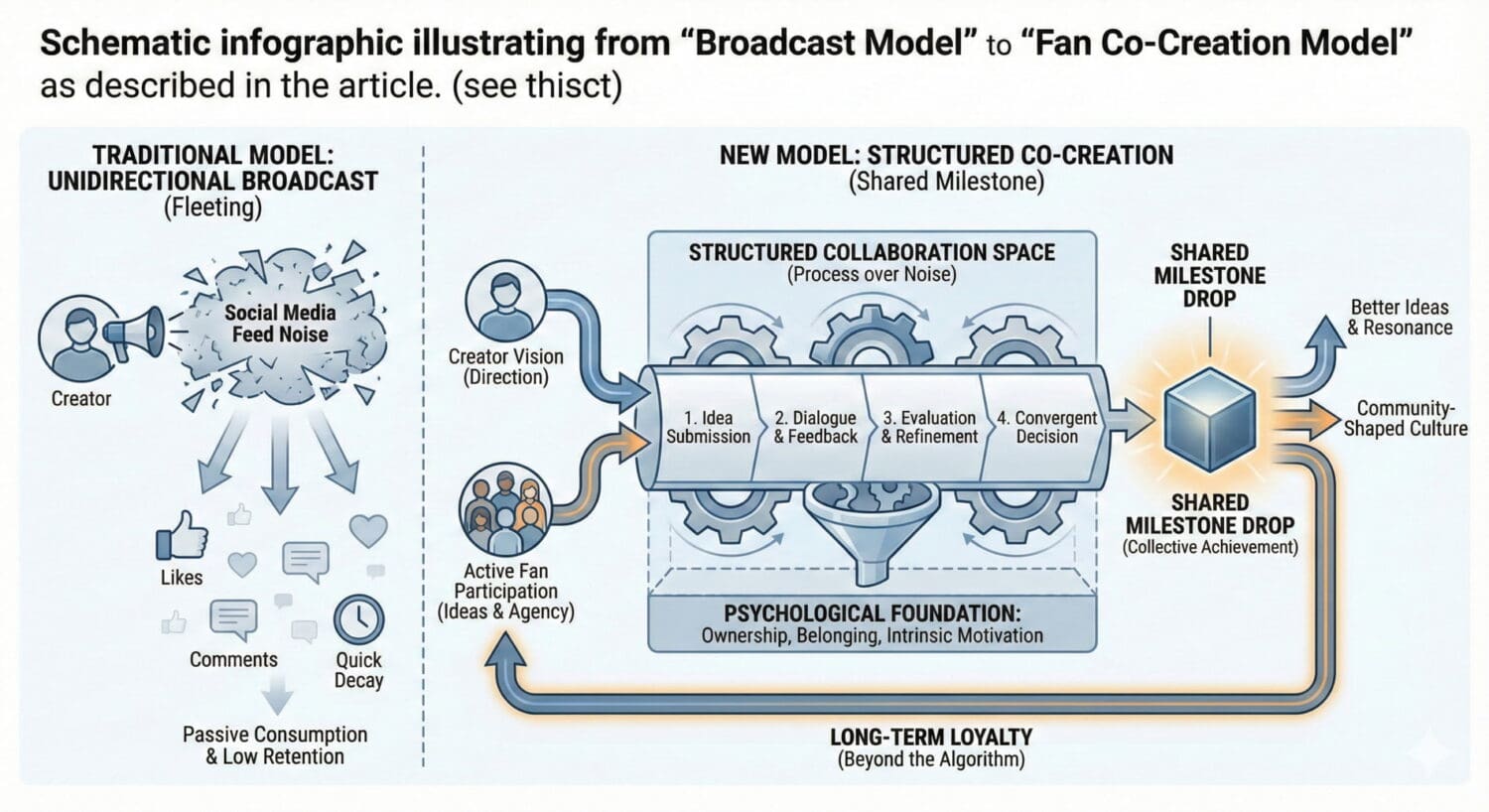
Traditionally, the culture industry stages the moment of release—the so-called “drop”—as an act of revelation. Whether it’s a limited-edition sneaker, a new album, or a digital design asset: the process resembles a play with clearly assigned roles. The creator works in seclusion, inside a “black box” of creativity, while the audience remains in passive anticipation until the curtain falls. This moment is binary; there is only the before of secrecy and the after of consumption. But the prompt “Imagine: your community helping shape your next drop” breaks with this decades-old convention. It outlines a scenario in which the creative process is no longer hermetically sealed, but designed to be porous and participatory.
This new paradigm is far more than a mere marketing strategy to increase interaction rates. It marks a fundamental shift in the psychology of digital value creation. We are moving away from a transactional economy, where finished products are exchanged for attention or money, toward a relational economy, where the value of a product is defined by the shared journey of its creation. In a digital landscape characterized by fleeting content and algorithmic arbitrariness, users yearn for depth and agency.
If we take this shift seriously, we must understand exactly what happens when the boundary between producer and consumer blurs. This is not about outsourcing work to the masses, but about the psychological architecture of belonging. When the drop is no longer just the work of an individual, but the crystallized result of a collective effort, everything changes: the motivation of those involved, the emotional bond to the product, and the longevity of the community itself.
The Psychological Foundation: Why We Love What We Co-Create
To understand the power of community drops, we must look deep into behavioral psychology. A central concept at work here is the so-called IKEA effect, described by Michael I. Norton and colleagues in the Journal of Consumer Psychology. Their research impressively demonstrated that people attribute a significantly higher value to products they helped create—often comparable to the appreciation for expert work. So, when fans don’t just click the “buy” button but participate in decisions about colors, features, or narrative elements during the development phase, they charge the product with their own identity. The drop becomes an extension of their self, an artifact of their own efficacy.
This mechanism corresponds directly with Self-Determination Theory, which has shaped motivation research for decades. According to Deci and Ryan, human motivation is largely driven by three basic psychological needs: competence, autonomy, and relatedness. A classic, unidirectional drop satisfies none of these needs on a deep level; the fan is merely a consumer. A co-creative process, however, addresses all three. The user experiences competence by having their opinion heard and validated; they experience autonomy by influencing the final result; and they feel relatedness (social connectedness) by being part of a group working together toward a goal.
Studies on Online Collaborative Innovation Communities show that this psychological activation leads to a form of loyalty that cannot be achieved with conventional loyalty programs. Anyone who has experienced their input actually changing a product develops psychological ownership. The product no longer feels like it belongs solely to the creator or the brand, but also to the fan. In a time when digital goods are often perceived as fleeting and interchangeable, this feeling of co-ownership is the strongest anchor against the erosion of attention.
Beyond the “Genius Myth”: The Quality of Collective Intelligence
For a long time, the myth of the solitary genius persisted in the creative industries—the idea that true innovation can only arise in the isolation of a brilliant mind. But the reality of digital networks belies this romanticism. When communities are meaningfully integrated into the process, it not only serves emotional bonding but demonstrably increases the quality of the output. Eric von Hippel of MIT coined the term Lead User Innovation for this. His research at MIT Sloan shows that engaged users often anticipate needs and solutions long before the manufacturer recognizes them. In a co-creative drop scenario, the community functions as a massively parallel processor for idea validation.
The variety of perspectives within a community—so-called cognitive diversity—prevents the tunnel vision that creators often develop when working on a project in isolation for too long. An article in Nature Human Behaviour underscores that collective intelligence works best when independent opinions can be aggregated without early groupthink emerging. Here lies an enormous opportunity for the next drop: Instead of guessing what might be well-received, the product is honed through the filter of hundreds or thousands of individual experiences. The result is often more robust, culturally relevant, and less prone to market failure.
However, it is crucial to emphasize that this does not mean the creator gives up their vision. Rather, their role transforms from sole author to curator and conductor. The art lies no longer just in creating content, but in synthesizing feedback. The creator must filter the signals from the noise and mold the community’s impulses into a coherent form. If this succeeds, a product is born that possesses inherent market resonance before it is even officially released.
The Dilemma of Feeds: Why Social Media Hinders Co-Creation
Despite the obvious advantages, many attempts at co-creation fail in practice. The reason often lies not in a lack of will, but in the wrong infrastructure. Most creators try to map these processes where their reach is: in the feeds of Instagram, TikTok, or X. But these platforms are architecturally optimized against depth and for speed. Current analyses, such as in Nature Communications, point out that the collective attention span is shrinking due to the acceleration of content. A social media feed is a rushing torrent; content appears and vanishes within hours.
Research on computer-mediated communication shows that complex collaboration requires persistence and structure. A creative thought must be allowed to mature, it must remain referenceable, and it must not be displaced by the next dopamine trigger. In a feed, discussion fragments immediately. Valuable feedback gets lost in the noise, context is lost, and the half-life of attention is too short for genuine reflection. Anyone trying to develop a complex drop via Instagram Stories is forcing a synchronous logic onto a process that requires asynchronous depth.
This is where the necessity of dedicated spaces becomes clear. Platforms like trendhub address this exact pain point by replacing the logic of the feed with the logic of the project. It is about creating spaces where ideas do not become obsolete but can be iterated upon. True co-creation requires an environment that promotes “Slow Thinking” (in the sense of Daniel Kahneman)—that is, the slow, analytical thinking necessary for problem-solving, as opposed to the fast, intuitive reacting that dominates social media. Without such a structured space, the call for participation often remains merely a performative gesture without substantial results.
From Audience to Alliance: The Economic Dimension
Viewed through an economic lens, the co-creative drop transforms the entire value chain. In the classic model, the creator bears the full risk: they invest time and capital in production without knowing if the result will resonate. In the participatory model, however, marketing and market research shift to the beginning of the chain.
This leads to a more efficient allocation of resources. Instead of spending budget on expensive launch campaigns, energy is invested in moderating the existing community. The data is clear here: acquiring a new customer is, according to the Harvard Business Review, significantly more expensive than activating an existing one. When the community helps shape the drop, members become natural ambassadors. They share the project not because they are paid to, but because they are proud of “their” work. Word-of-mouth in this context is not a stroke of luck, but a structural consequence of the process.
Furthermore, a new form of social currency emerges. In a world of abundance, exclusivity is a high value. But the exclusivity of a co-created drop feeds not only on artificial scarcity but on access to the process. The privilege of “having been there” when the decision on the design was made weighs heavier for many fans than the physical product itself. This enables creators to develop new monetization models based not on the sale of end products, but on the sale of access and influence.
The Cultural Shift: The Drop as a Shared Ritual
On an even higher level of abstraction, we must ask what this development means for our culture. We are experiencing a shift away from authoritarian cultural production toward a discursive culture. The co-created drop is a ritual of confirming shared values. When a community decides together on the aesthetic of a new merchandise item or the sound of a new track, it is implicitly negotiating its own identity.
This strengthens the resilience of the group. Sociological analyses show that groups with high participatory density are more stable. It is important to realistically assess the 1-9-90 principle of internet culture: only about 1% of users create content, 9% edit or interact with it, and 90% just watch. But for the success of a community drop, it is not necessary for 100% to actively design. The act of watching the engaged 10% shape the drop is also valuable for the passive 90%. A narrative emerges, a history of creation that is consumed by the passive members as well. Transparency is key here: the process must be visible so that it exerts a binding effect even on the non-active members.
The Future Belongs to the Curators of Collaboration
The call “Imagine: your community helping shape your next drop” is thus far more than a nice idea for more engagement. It is an answer to the crisis of attention and alienation in the digital space. We have created the technical possibilities to connect everyone with everyone else, but we have mostly used these connections for trivial impulses. True innovation now lies in using this connectivity for complex, creative processes.
A drop that grows from the center of the community is resistant to the rapid decay of trends because it is built on relationships, not hype. It respects the intelligence of fans and harnesses the creative potential slumbering in swarm intelligence. For creators, this means a bold step: accepting a partial loss of control in exchange for relevance and loyalty. In the future of the Creator Economy, the most successful artist may not be the one with the loudest megaphone, but the one who asks the best questions and is best able to hold the space for the answers.